
Alabama Women's Hall of Fame
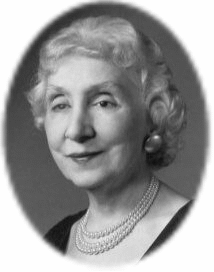
On December 4, 1891, Florence became the second child of Howell Rose Golson and Alabama (Bama) Goldsmith Golson. In 1895, the family moved from Fort Deposit to Wetumpka, Alabama, where Mr. Golson practiced law and later became the publisher of the Weekly Herald. Throughout much of her childhood, Florence demonstrated exceptional talent. Before the age of twelve, she improvised songs and piano pieces for her own amusement. Her parents encouraged her talent through piano and voice lessons. At age nine, however, Florence suffered a childhood accident that caused her to gradually loose her sight. By age fifteen, she had become totally blind.
She attended the Tennessee School for the Blind at Nashville for two years and returned to study at the Womens's College in Montgomery (Huntingdon College). In 1920, she graduated from the Cincinnati Conservatory of Music at Cincinnati, Ohio in voice and composition. After graduation she went to New York, where she was coached by Walter Golde and studied orchestration with Fred Jacobi. For the next three years, Florence toured under the management of H.F. Richards of Cincinnati and Charles Drake of New York.
Aside from her career as a performer, Florence also had a career as an accomplished composer. Her first piece "The Bird with a Broken Wing," was dedicated to Helen Keller, whose life and work inspired Florence. Another piece "A Spring Symphony," (a cantata for women's voices) won her several honors and awards, most notably the Ohio Music Teachers Association. In New York, the Rubinstein Club gave its premier performance.
On March 23, 1923, Florence married her childhood sweetheart, Winton W. Bateman and moved to College Park, Georgia, where her husband served as a pharmacist and several terms as mayor. Florence began her teaching career and promoted public school adoption of music programs. In 1936, the Bateman's returned to Wetumpka where Mr. Bateman purchased the Wetumpka Printing Company and served as its business manager until his death in 1942.
After returning to Alabama, Florence became involved in several music clubs and associations. For example, while on the executive board of the Alabama Federation of Music Clubs, Bateman served as committee chairman for American Music and Library Research. She was a life member of the National Federation of Music Clubs (president of the Selma-Montgomery branch); secretary and chairman of the Montgomery's Music Study Club's International Music Relations, a member of the Southeastern Composers League and many others.
Throughout the nation, Florence has been recognized for her musical contributions. In November 1949, the Department of Archives and History in Montgomery unveiled a life size oil portrait of Florence Golson Bateman in their Music Room. In 1954, the Alabama Federation of Music Clubs dedicated the Florence Golson Bateman studio at the Transylvania Music Camp in Brevard, North Carolina. In the 1970's she was included in the sixth and seventh edition of Who's Who of American Women and also listed in the Who's Who in Alabama with Notable Women (1973). Florence remained in Wetumpka until her death, at age 96.
 Other Inductees
Alabama Women's Hall of Fame