
Alabama Women's Hall of Fame
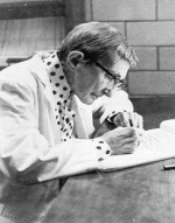
After becoming Professor Emeritus of Anatomy and Consultant of Neurosurgery at the University of Michigan Medical School, Dr. Elizabeth Crosby began another phase of her career by establishing an association with the Department of Anatomy at the University of Alabama in Birmingham. She came to UAB in 1963 as Professor Emeritus in the Department of Anatomy. So began a period of almost twenty years in which Dr. Crosby, already a world recognized scientist and teacher, influenced students, faculty, and physicians through her profound understanding of the nervous system and her complete selflessness in teaching.
During her years in Alabama, Dr. Crosby, who touched many lives, organized a group of researchers to study comparative neurology. The declared objective of this group was to produce a new reference work in comparative vertebrae neuroanatomy. Although a work on the telencephalons finally resulted from the group's efforts, it became apparent to the participants that Dr. Crosby's intention was to stimulate a renewed interest in research in this important area. The idea of a book was but the bait.
Dr. Crosby was deeply involved in the research conducted by sixteen UAB students who earned Ph.D. degrees in the neuroanatomical sciences. Today, these graduates are actively engaged in education, research, and medicine. Their careers reflect favorably upon UAB. Research by faculty members in collaboration with Dr. Crosby was published and presented in both national and international forums, resulting in the early foundation of UAB as a strong, active, academic institution.
Her driving efforts to understand and to teach as much as possible about the nervous system led to recognition at all levels of the scientific world; her research projects and published works are far too numerous to mention here. Her achievements resulted in her being awarded nine honorary doctoral degrees. Further, UAB named her Distinguished Faculty Lecturer, and President Jimmy Carter in 1980 awarded her the National Medal of Science.
Despite the demands of her profession, Dr. Crosby was a warm and compassionate person and extremely generous. To her students and colleagues she was a personal confidante, ever ready to help. Praise was her strongest motivator. In a world hungry for power, wealth, and status, Elizabeth Caroline Crosby was an anachronism of modesty and self-effacement. Certainly, Alabama is better for the years of influence exerted by this most remarkable woman.
Bibliography
Crosby, Elizabeth Caroline and H.N. Schnitzlein. Comparative Correlative Neuroanatomy of the Vertebrate Telencephalon. New York: MacMillan, 1982.
----, et al. Correlative Anatomy of the Nervous System. New York: MacMillan, 1962.
Herrick, Charles Judson and Elizabeth C. Crosby. A Laboratory Outline of Neurology. Philadlephia: W.B. Saunders Company, 1918.
Kappers, C.U. Ariens, et al. The Compartative Anatomy of the Nervous System of Vertebrates, Including Man. New York: MacMillan, 1936.
 Other Inductees
Alabama Women's Hall of Fame