
Alabama Women's Hall of Fame
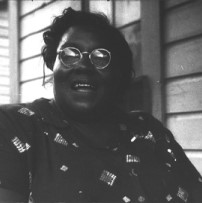
Born in 1902 in Payneville, Alabama, just outside of Livingston in Sumter County, Vera Hall grew up to establish one of the most stunning bodies of American folk music on record.
Hall married Nash Riddle, a coal miner, in 1917 and gave birth to their daughter, Minnie Ada. Riddle was killed in 1920. Though Hall sang her entire life, learning spirituals such as “I Got the Home in the Rock” and “When I’m Standing Wondering, Lord, Show Me the Way” from her mother, Agnes, and her father, Efron “Zully” Hall, it was not until the late 1930s that Hall’s singing gained national exposure.
John Avery Lomax, ethnomusicologist, met Hall in the 1930s and recorded her for the Library of Congress. Lomax wrote that she “had the loveliest voice [he] had ever recorded.” The British Broadcasting System played Hall’s recording of “Another Man Done Gone” in 1943 as a sampling of American folk music. The Library of Congress played the song the same year in commemoration of the 75th Anniversary of the Emancipation Proclamation. In 1945, Hall recorded with Byron Arnold. In 1984, the recordings were released as a Collection of Folksongs entitled Cornbread Crumbled in Gravy.
In 1948, with the help of Alan Lomax, Hall traveled to New York and performed on May 15 at the American Music Festival at Columbia University. During the course of this trip, Lomax interviewed Hall on several occasions. In 1959, these interviews would be transformed into Rainbow Sign, a thinly- guised biography of Hall. In this book, Lomax stated, “her singing is like a deep-voiced shepherd’s flute, mellow and pure in tone, yet always with hints of the lips and the pleasure-loving flesh... The sound comes from deep within her when she sings, from a source of gold and light, otherwise hidden, and falls directly upon your ear like sunlight. It is a liquid, full contralto, rich in low overtones; but it can leap directly into falsetto and play there as effortlessly as a bird in the wind.”
Today, her work still garners attention. In 1999, techno-artist, Moby (Richard Melville Hall), included her voice and song “Troubled So Hard” in his multi-platinum album Play, thus introducing Hall’s voice to a whole new generation of listeners. Prized by scholars and folksong enthusiasts, Hall’s recordings include examples of early blues and folk songs that are found nowhere else. Her masterful renditions of traditional songs and stories are a defining part of Southern Black culture and the Black Belt region.
Recording
of "Another Man Done Gone"
View induction speech given by Gabriel Greenberg
 Other Inductees
Alabama Women's Hall of Fame