
Alabama Women's Hall of Fame
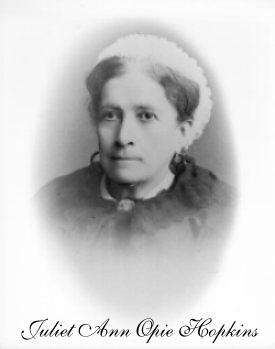
Juliet Opie Hopkins was the wife of prominent Mobile businessman and political leader Arthur F. Hopkins. In June 1861, while she was in Virginia, she began organizing medical and supply services to assist sick and wounded Alabama soldiers, who at the time were not provided with adequate medical services by the Confederate Medical Department.
Her voluntary efforts grew in size and scale through the summer, as groups in Alabama sent supplies and money to assist her in her efforts. In August, she established the first of three hospitals in Richmond to provide a place of care and recovery for Alabamians. By November she had established a second, larger hospital, and a third hospital followed in the Spring of 1862. In its November 1861 session, the Alabama legislature assumed responsibility for supporting these hospitals, appointing Judge Hopkins the agent for Alabama in Virginia and Mrs. Hopkins the superintendent of any hospitals the agent might establish.
Just the establishment and continued operation of these hospitals was a remarkable achievement. It was even more remarkable for a woman to emerge in such a position of leadership and responsibility. But the most remarkable aspect of Mrs. Hopkins' work was the level of personal care and attention she and her colleagues provided. Surviving records are filled with letters reflecting her efforts in behalf of the sick and wounded who found themselves in her care. All of these letters reflect a tenacious dedication to the personal care of each patient in a time when the numbers of sick and wounded tended to overwhelm and deaden the sensibilities of the people responsible for their care.
With the increasing costs and shortage by late 1863 and also the consolidation of services by the Confederate Medical Department, Mrs. Hopkins felt obligated to close her hospitals in October and to transfer her patients and supplies to the Confederate hospitals. She returned to Alabama to continue her work in hospitals in the state, serving there until the end of the War.
Mrs. Hopkins' husband died in late 1865, and Mrs. Hopkins left Alabama to live on property she owned in New York. She had lost most of her and her husband's wealth in the War and lived the rest of her life in relative poverty. She died in 1890 in Washington, D.C., in the home of her adopted daughter, also named Juliet. She was buried at Arlington Cemetery, and the members of the Alabama congressional delegation served as her pall bearers.
 Other Inductees
Alabama Women's Hall of Fame